Yesterday, 5 March 2026, negotiators from the European Parliament, the Council and the Commission reached an agreement on the restrictions to be imposed on the designations permitted for plant-based food products, after a previous attempt last December had come to nothing, as we reported in this article.
The framework of the agreement is the revision of the Regulation on the Common Market Organisation (CMO) for agricultural products. The European Commission had put forward a proposal to ban the use of 29 traditional terms, to which the European Parliament responded with an even more restrictive list, which would have included terms such as “hamburger”, “burger” and “sausage”.
The outcome of the negotiation is a ban extended to 31 terms (two more than the Commission’s initial proposal). Among these are also very common words found on the packaging of plant-based products currently on the market, such as chicken and steak.
It should be noted, however, that contrary to the proposal discussed in December, the most widespread designations in the plant-based alternatives market, such as burger, ham, sausage and salami, will remain permitted.
Nevertheless, as requested by the Parliament, the ban will also apply to cultivated meat products, even though they are not yet present on the European market. A pre-emptive choice that speaks volumes about the underlying political intentions — tied to safeguarding the interests of the meat industry rather than to far-sighted decisions such as encouraging the shift towards more sustainable protein sources.
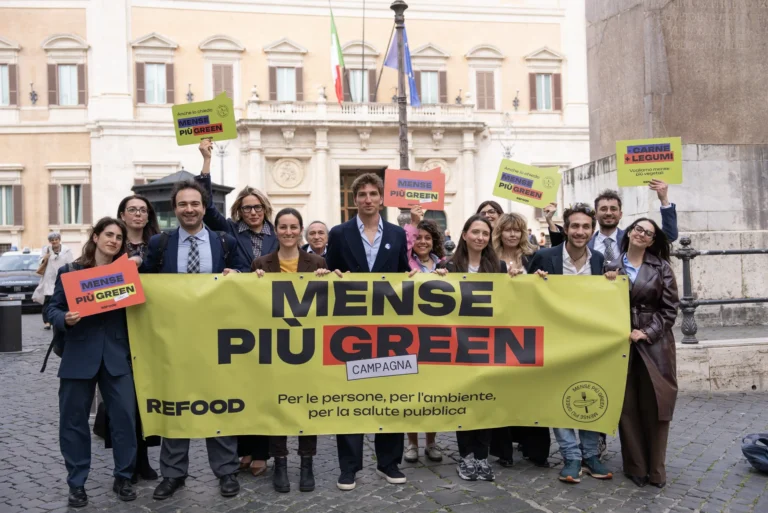
In recent months, more than 600 civil society organisations, including ourselves at REFOOD, had joined the No Confusion campaign, signing an open letter against any unnecessary restriction. This mobilisation helped prevent an extension of the ban to entirely generic terms that have become established in everyday use, such as “burger” and “sausage”, which would have been wholly unreasonable.
Three years allowed for adaptation
The technical details of the text will be finalised next week. After that, the measure will need to be formally approved by the Agriculture and Fisheries Council, with a vote by member state ministers, and then by the European Parliament in plenary session.
The draft provides that producers will have a three-year transition period to run down existing stocks and adapt labels and communications to the new requirements after the regulation enters into force.
Who does this ban really benefit?
The European Commission justified its original proposal with the need to “improve transparency for consumers” and “preserve the cultural and historical meaning of meat terminology”. These are arguments that do not hold up to scrutiny: numerous surveys have disproved the possibility that consumers are genuinely confused by current labelling.
In 2024, the Court of Justice of the European Union had already ruled that existing legislation was sufficient to protect consumers from possible confusion. The European Parliament had rejected similar proposals in 2020. In the meantime, the political climate has changed, and agribusiness lobbies have become more combative.
Who benefits from this restriction? Not consumers, nor individual farmers, who could in fact find growing opportunities precisely in the conversion towards plant protein production such as soya, peas, oats, and legumes. The main beneficiary is, essentially, the traditional meat industry, which does not want to lose consumers attracted by more sustainable and increasingly competitive alternatives.
It is precisely the use of common everyday words that the livestock sector finds hard to stomach, because it helps consumers understand how to cook a product, how to pair it, and how to incorporate it into their daily habits.
A retrograde choice
A Europe that aspires to be a leader in the ecological and food transition cannot afford to wage war on words. While the world accelerates towards more sustainable food systems, Brussels is debating whether the term steak can appear on a soya-based product.
It is a retrograde choice, one that adds bureaucracy where innovation is needed, creates barriers where opportunities are needed, and sends the wrong signal to a sector — that of plant-based foods — which is already worth €2.7 billion in Europe and could be one of the drivers of the protein transition the continent so urgently needs.
The banned words
Below is the official list of banned designations agreed yesterday (in brackets an approximate Italian translation, not official):
Beef (manzo), Veal (vitello), Pork (maiale), Poultry (pollame), Chicken (pollo), Turkey (tacchino), Duck (anatra), Goose (oca), Lamb (agnello), Mutton (montone), Ovine (ovino), Goat (capra), Drumstick (coscia di pollo), Tenderloin (filetto), Sirloin (controfiletto), Flank (pancia / taglio di fianco), Loin (lombo), Ribs (costine), Shoulder (spalla), Shank (stinco), Chop (braciola), Wing (ala), Breast (petto), Thigh (coscia), Brisket (punta di petto), Ribeye (entrecôte / costata), T-bone (bistecca con osso a T), Rump (scamone), Bacon (pancetta), Steak (bistecca), Liver (fegato).
We will update the article with the official Italian list as soon as it becomes available.