The handshake that set the web ablaze
There is a photograph that sums up, better than many words, the moment plant-based food is living through in Italy. Two men in jackets shake hands and smile: on one side Flavio Amadori, on the other Stanislao Fabbrino, president of Granarolo. It is 8 May 2026, and with that handshake Italy’s leading poultry producer announces it has bought Unconventional, the country’s best-selling plant-based meat brand.
The reaction from part of the vegan and animal-rights community arrived within hours, and it sounded more or less like this: «We will not give our money to those who do business on the slaughter of chickens». A full-blown call for a boycott. The short circuit is obvious: a burger born to be an alternative to animal farming ends up in the hands of those who run those farms, holding roughly 30% of the national poultry market.
And yet, before picking a side, it is worth taking a step back and looking at the whole picture. Because the real question is not whether Amadori is an “awkward” buyer, but whether this acquisition is the sign that alternatives to meat have become increasingly credible and ready to win market share. After all, if the goal is to reduce the number of animals farmed and slaughtered, what matters more: the purity of those selling plant-based products, or the amount of those products that ends up in shopping carts? That, most likely, is the lens through which to read this story, without letting ideology cloud the view.
Anatomy of a deal
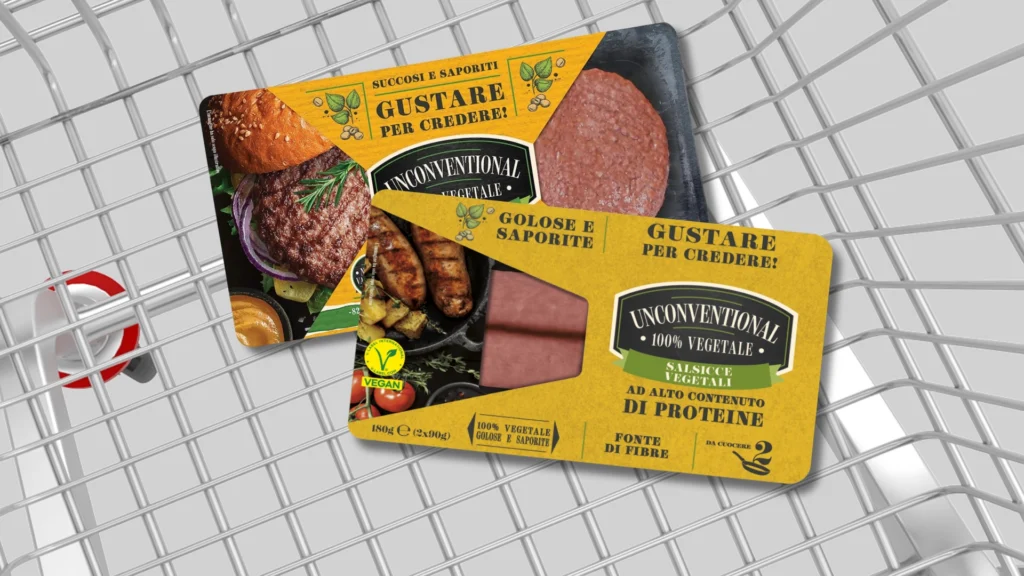
On paper, the deal is straightforward: Amadori takes over 100% of Unconventional S.r.l., a company founded in 2020 by Granarolo, together with the plant in Coriano, in the province of Rimini, and the «Unconventional 100% Vegetale» brand. The site’s entire workforce moves to the Cesena-based group, which counts more than 9,400 employees in Italy. The financial terms were not disclosed; the law firms Gianni & Origoni and Gnudi advised Amadori, Euromerger advised Granarolo.
With this move Amadori becomes the third branded player in the Italian market for plant-based meat substitutes — a segment of burgers, sausages, deli slices and cutlets that in 2025 exceeded 208 million euros and is now present in 28.7% of Italian households. Widening the view to all plant-based alternatives to meat, including tofu, tempeh and seitan, the figure reaches 234 million euros, according to Circana data processed by the Good Food Institute Europe. Still ahead are Valsoia, the historic leader, and Garden Gourmet, the brand owned by Nestlé.
Who the buyer is speaks for itself: Amadori calls itself «The Italian Protein Company» and has built a multi-protein portfolio: chicken and turkey, eggs, pork with the Lenti brand, and plant-based with the Veggy line. Unconventional is therefore the missing piece. «An important acceleration», is how CEO Denis Amadori described it. On the other side, Granarolo explains the sale with the intention to «simplify the business model» and focus on milk and dairy.
What makes the affair almost symbolic is Unconventional’s own story. Launched at the height of the pandemic, in March 2020, its pea-protein burger became Italy’s best-selling in just a few years, capable of beating giants like Beyond Meat and Impossible Foods in blind taste tests. A product born as a flagship of the alternative to meat, today owned by a meat producer.
The two camps
On one side, the critics. Their argument is intuitive and carries real moral weight: buying that burger today ultimately means sending money to a group that farms and slaughters millions of animals. For those who had chosen Unconventional precisely so as not to fund that supply chain, it is an “unsolvable dilemma”, as it has been called.
On the other, the realists. And their arguments are more solid than gut feeling suggests.
- First: Unconventional was not a company of activists — it was already owned by Granarolo, a dairy giant, and the dairy industry is no more “cruelty-free” than the meat industry. Whoever bought that burger yesterday was funding a livestock giant anyway.
- Second: Amadori’s distribution network can bring plant-based meat where it never reached before (even into butcher shops!), and at more competitive prices, winning over flexitarians — precisely the audience that moves volumes. And prices are already moving: between 2023 and 2025 the average price per kilo of meat alternatives fell by 3%.
- Third, and most counterintuitive: the more revenue plant-based products generate, the more incentive large groups have to shift resources and industrial capacity from slaughter to plants.
The arguments of this camp can be summed up like this: change shows up in the big numbers, so it is not driven by a few thousand perfect vegans but by millions of omnivores who want to reduce their meat consumption.
The plant-based sector is shedding its skin
That Amadori, Granarolo, Nestlé and Danone are competing for shelf space in plant-based alternatives is no small detail: it is proof the sector has left its niche. In Italy the plant-based retail market reached 669 million euros in 2025 (+4.5% on 2024), with volumes up 5.8% in the year and 12.7% over two years. Above all, unit sales grew 16.9% in two years: it is not prices that are rising, but real consumer demand. And it is not only the industrial giants fighting over this market: large-scale retailers are also pushing their own plant-based private labels, which are growing faster than branded products (+6.7% versus +5% by volume). In Europe, according to Circana, the market reaches 16.3 billion, though still only 2.4% of fast-moving consumer goods.
It would be dishonest, though, to tell only the upbeat half of the story. In Italy too the pace has changed: meat alternatives are still growing by volume (+4.1% in 2025), but far less than the previous year’s +16.3%. It is not a reversal of the trend: it is the physiology of a market leaving its pioneering phase. And elsewhere, plant-based products that imitate meat are in real trouble: distrust of ultra-processed foods is growing, the price premium persists, and the numbers show it. In the United States, Beyond Meat’s stock crashed more than 56% in a single session in October 2025, after a debt restructuring; two cultivated-meat startups, Meatable and Believer Meats, shut down at the end of 2025; and even Nestlé pulled Garden Gourmet from the United Kingdom and Ireland, admitting it had bet too heavily on imitating meat.
Even the flexitarian figures are contested: according to Circana they are growing (31% in Europe), while a study by Umeå University says they are declining (16%) — simply because eating less meat has become so normal that few people bother to label themselves anymore. It is against this landscape — mature, consolidated, at times ruthless — that the sale of Unconventional should be read. Not as an exception, but as a symptom: when a market grows, the big players move in. And so the question becomes: who, in this market, has actually built something? The best stories are not those of companies buying plant-based, but of companies that became plant-based.
Who owns what
| Brand | Ownership today | In short |
| Valsoia | Listed (Euronext Milan) | Italian leader; €116.8M (2024); ~80% of plant-based ice cream |
| Garden Gourmet | Nestlé | “European leader” in plant-based; no. 2 in Italian meat substitutes |
| Unconventional | Amadori (from Granarolo, 2026) | Italy’s best-selling pea burger |
| Alpro | Danone (via WhiteWave) | EU plant-drink pioneer; ~43% of the European market |
| The Bridge | Ambienta SGR (2026) | Organic pioneer; ~€45M; ~80% exports |
| Kioene | Tonazzo family | Former meat company (since 1888), now 100% plant-based |
| Heura / Planted | Independent | Startups (Spain / Switzerland): activism and food tech |
The (true) stories of those who believed in it
The butcher that stopped selling meat
The most powerful story comes from Villanova di Camposampiero, in the province of Padua. Here, since 1888, the Tonazzo family had practised one precise trade for five generations: meat. Yet as early as the 1990s it had created Kioene, today one of Italy’s most important 100% plant-based companies. And on 16 September 2024 it made an announcement no other meat company in Italy had ever dared: from 31 December it would close all its meat-related activities to dedicate itself solely to plant-based food.
«Our family has worked in meat for five generations — explained Stefano Tonazzo — but today we announce the decision to close all our activities in the meat sector to concentrate every effort on plant proteins».
Not an improvised move: even before the pivot, 270 of the 300 employees worked in the plant-based business, and Kioene accounted for over 60% of profits, with revenues of 53.4 million in 2023 and an estimate close to 65 by the end of 2024. The workers in the meat department were retrained, not laid off.
The epiphany, as Kioene founder Albino Tonazzo has recounted, had come years earlier during a trip to Brazil: an endless line of trucks loaded with soy destined for animal feed, and the discovery that the energy needed to produce one animal protein is enough for twelve plant proteins. «An absurd ratio». Here it is not meat buying plant-based: it is meat becoming plant-based. The exact opposite of the Amadori case, and proof that it can be done.
When scale is an ally: Alpro
If Tonazzo is the story of courage, Alpro is the story of industrial scale. Born in Belgium in 1980 within the Vandemoortele group, the European pioneer of soy milk changed hands several times — Dean Foods in 2009, the WhiteWave spin-off in 2013 — before landing in 2017 at Danone, which acquired WhiteWave for 12.5 billion dollars.
Far from smothering it, the large group strengthened it: Danone set itself the goal of tripling its worldwide plant-based sales to around 5 billion euros, with Alpro as its flagship brand, today holding around 43% of the European plant-drink market. The lesson is uncomfortable for purists but hard to ignore: a giant’s economies of scale can be an ally of the transition, not necessarily a threat.
The Italian organic pioneer that chose a fund: The Bridge
The same pattern, in an Italian, small-cap version, is told by The Bridge. It was founded in 1994 in San Pietro Mussolino, in the mountains near Vicenza, from the intuition of Ernesto Negro Marcigaglia, who closed down his leather-glove business to create Italy’s first organic rice drink. The company now generates around 45 million euros in revenue, 80% of it from exports. In April 2026 the majority stake passed to the Ambienta fund, which specialises in environmental sustainability, with the founding family reinvesting and staying on. A family pioneer that, in order to grow, consciously chose to enter the orbit of a structured investor.
The champion that diversified: Valsoia
And then there is Valsoia, the elder statesman. Founded in Bologna in 1990 by Lorenzo Sassoli de Bianchi, Italy’s soy pioneer and listed on the stock exchange since 2006, it now generates 116.8 million euros in revenue and dominates plant-based ice cream with around 80% of the market. But Valsoia is no plant-based purist: it has acquired historic non-vegetal brands (from Santa Rosa to Pomodorissimo) and even distributes Häagen-Dazs ice cream in Italy, made with milk and cream. Even the home champion, in short, grew by mixing its cards. A good antidote to any purism.
Who stays independent (and who shouts loudest)
Not everyone, though, ends up inside a large group or a fund. Some choose — or hold out for — the independent route. Spain’s Heura, born in Barcelona in 2017, is the loudest example: it calls itself a brand of «good rebels», uses olive oil as its only fat and has turned activism into a marketing language, with provocative billboards («a beef burger pollutes more than your car») and messages aimed straight at policymakers. It generates around 38 million euros in revenue and has raised almost 90 million dollars; it arrived in Italy in 2021.
Switzerland’s Planted, a 2019 spin-off of ETH Zurich, plays the technology card instead: extrusion and fermentation, clean labels, “whole cuts” that mimic muscle, and over 120 million dollars raised. How long one can stay independent, in a consolidating market, is one of the sector’s open questions.
What’s at stake
Back, then, to the handshake of 8 May. Boycott or celebrate? The answer depends on what you measure. If the metric is the moral consistency of a single brand, the Unconventional acquisition is a stain. If the metric is the number of animals that never end up on a farm, then what counts is volume — and volumes are moved by large groups and by the millions of flexitarians who buy a plant-based burger at the supermarket without feeling part of any battle.
Seen this way, the sale of Unconventional is not the betrayal of a cause: it is the ambiguous, somewhat hard-to-swallow price of its success. Plant-based food has become important enough to whet the appetite of those who sell meat. And a meat company investing in plant-based — whatever one makes of it — is a company shifting part of its resources, even if only out of calculation, away from animal farming.
That is why the real battle, for those working on the transition, is not against a single brand or a logo on the shelf. It is against the misinformation that holds back informed choices and against the barriers that still make plant-based food less accessible — starting with the canteens of schools, hospitals and public institutions, where all too often a balanced plant-based option simply does not exist. What is at stake, after all, is not only ethical: according to an analysis by Systemiq, an Italian alternative-protein supply chain could generate 10 billion euros of added value and around 31,000 jobs. The day buying plant-based is easy, affordable and normal for everyone, it will no longer matter much who owns which brand. It will be the sign that the transition has truly happened.