

If you’ve ever stood in front of a shelf wondering which product to choose among seemingly similar packages, you know how difficult it can be to find your way. Soy yogurt, biscuits, ready meals or plant-based drinks may look almost identical at a glance, despite having very different amounts of sugar, saturated fat or salt.
The point is that the information is there, but it isn’t always easy to read at the moment it’s needed: when you’re deciding what to put in your trolley.
This need is what gave rise to front-of-pack nutritional labelling systems, also known as front-of-pack or FOP systems: models that display certain nutritional information on the front of the package, with the aim of making it quicker to read a product’s characteristics and helping the consumer find their way.
Among these systems, the most debated in Europe is Nutri-Score. In recent years it has become central to the public policy debate on food and health. Despite this, at European level it is not currently a mandatory system.
To understand why it’s talked about so much, and why some countries support it while others propose alternative models, we need to start with a simple question: what can a label placed on the front of a package really do?
What is meant by front-of-pack nutritional labelling
Front-of-pack nutritional labelling is a simplified form of presenting nutritional information. Unlike the mandatory nutrition table, which is usually found on the back or side of the package, this type of information is placed on the front of the product.
Its function is to help the consumer find their way more quickly. The nutrition table requires time and attention. A front-of-pack system instead tries to offer a first signal, one that is more visible and immediate.
This doesn’t mean that the front-of-pack label can tell the whole story. It doesn’t explain on its own the overall quality of a diet, it doesn’t say how often to consume a food, and it doesn’t replace reading the ingredients or nutritional values.
It can, however, help make an initial comparison, especially between products in the same category: for example, two soy yogurts, two packs of breakfast biscuits, two plant-based drinks or two ready meals. It is less useful, on the other hand, if it is interpreted as an absolute judgement between very different foods, such as a soy yogurt, a snack cake and a cooking oil.
For this reason, front-of-pack nutritional labelling has also become a public policy issue. It doesn’t just concern how a package looks on the shelf, but the relationship between information, health, the market and freedom of choice.
What Nutri-Score is
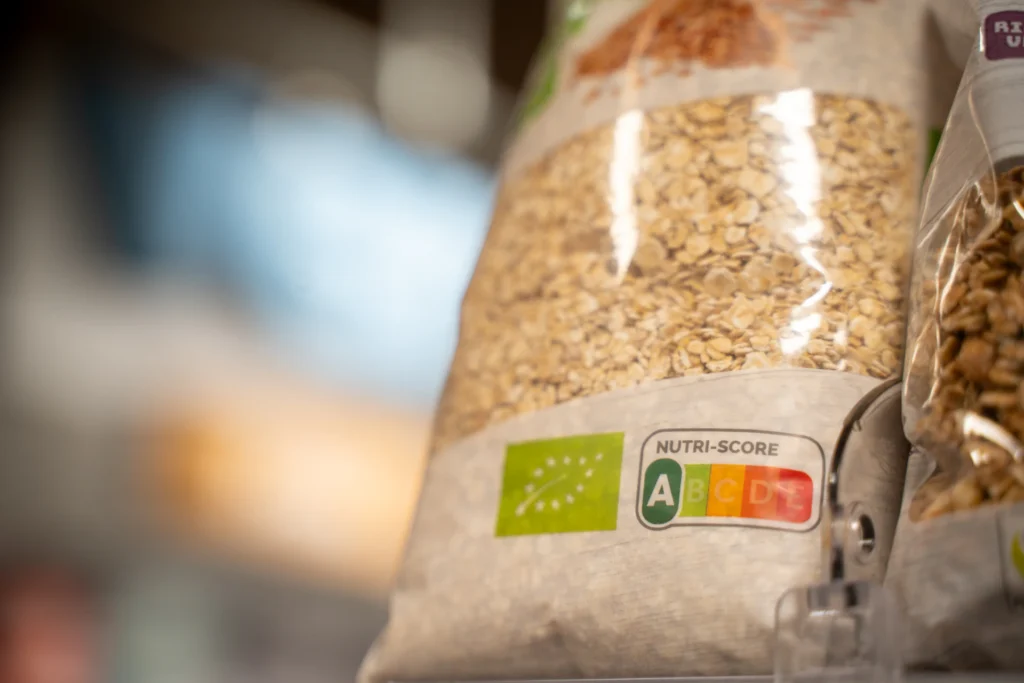
Nutri-Score, adopted or recommended on a voluntary basis by countries such as France, Belgium, Germany, Luxembourg, the Netherlands, Spain and Switzerland, is a front-of-pack nutritional labelling system that summarises the nutritional quality of a food through a scale made up of five letters and five colours.
The scale ranges from A, associated with the colour green and a more favourable rating, to E, associated with a darker colour and a less favourable rating. In front of a package, the consumer therefore finds an immediate visual signal: a letter and a colour.
Nutri-Score is based on an algorithm that takes into account components considered to be limited, such as sugars, saturated fat and salt, and components considered favourable, such as fibre, protein and the presence of fruit, vegetables, legumes or nuts. The result is then translated into the letter and colour shown on the package.
This signal does not describe every detail of the food. It doesn’t say, on its own, whether that product is suitable for everyone or whether it should be consumed often or rarely. However, it places it in a nutritional class and makes it easier to compare with similar products.
Its main function is in fact comparative. It can be useful, for example, when comparing two fruit yogurts, two breakfast cereals, two snack cakes, two ready meals, two plant-based drinks or two savoury snacks.
In these cases, the letter and colour can help identify nutritional differences more quickly that, by reading only the front of the package, would not be immediately apparent.
Yet this very immediacy is at the heart of the debate. For its supporters, Nutri-Score makes nutritional information more understandable and can guide people towards more informed choices. For its critics, on the other hand, the risk is that a summary classification is interpreted as an absolute judgement on the product, without taking into account the quantities consumed, frequency, overall diet and food traditions.
In other words, Nutri-Score tries to respond to a real need: making complex information more readable. But precisely because it simplifies, it raises an important question: to what extent is it possible to translate the nutritional quality of a food into a single symbol?
European regulation: what is mandatory and what isn’t
To correctly frame Nutri-Score, we need to start with European legislation on food information. The main reference is Regulation (EU) No 1169/2011, which governs the provision of food information to consumers.
This regulation sets out the requirements for food labelling. Among the information required is the nutrition declaration, which must be presented according to common criteria. The aim is to ensure that consumers receive accurate, clear and non-misleading information.
For the topic of front-of-pack nutritional labelling, Article 35 of the Regulation is particularly important. This article concerns additional forms of expression and presentation of the nutrition declaration. In other words, it allows nutritional information to also be presented through additional systems, provided they meet certain requirements.
These systems must be based on sound scientific evidence, must not mislead the consumer, must facilitate the understanding of nutritional information, and must not create obstacles to the free movement of goods in the internal market.
But there’s a problem: the European Union has not yet chosen a single mandatory model for all member states, and indeed front-of-pack nutritional labelling systems can be adopted on a voluntary basis.
As a result, Nutri-Score is one of the possible models, but it is not imposed by the European Union as a single system.
This explains why the topic is sensitive. On the one hand, the presence of multiple systems can meet the preferences of different countries. On the other, it can create exactly what FOP systems are meant to avoid, namely fragmentation and confusion for consumers, who may find themselves facing symbols and logics that are not always consistent.
Why the European Union is discussing a harmonised system
In recent years the European Commission has placed the issue of front-of-pack nutritional labelling within a broader framework: that of food policies, prevention, and the promotion of healthier and more sustainable diets.
With the Farm to Fork strategy, part of the European Green Deal, the Commission announced in 2020 its intention to work on a proposal for harmonised and mandatory front-of-pack nutritional labelling.
The goal was to make consumer information more uniform, reduce confusion between different national models, and facilitate the functioning of the single market. A common European system could, among other things, encourage companies to improve the nutritional composition of products, since a more visible assessment can influence purchasing choices.
The point, however, is that harmonising doesn’t just mean choosing a logo. It means deciding what type of information to offer European citizens and to what degree of simplification.
Should a label limit itself to reporting data? Should it interpret it? Should it help compare similar products? Should it take portions into account or be based on a standard quantity? Should it give an overall judgement or leave the consumer the task of interpreting the information?
These are technical questions, but also political ones, because behind a label there are different interests at play: public health, consumer protection, freedom of choice, the internal market, national food traditions and company strategies.
The other models in the European landscape
Nutri-Score, precisely because it is not mandatory, is not the only front-of-pack nutritional labelling system present in Europe.
Among the best-known models is the Keyhole, used in the Nordic countries. It is a positive logo: it doesn’t give a score to all products, but signals those that meet certain nutritional criteria within their category.
Another family of systems is that of nutritional traffic lights, such as the Multiple Traffic Light system developed in the United Kingdom. In this case there is no single overall judgement on the product, but colour-coded indications for individual nutrients, such as fat, saturated fat, sugars and salt.
There are also descriptive schemes based on reference intakes, including the NutrInform Battery promoted by Italy. These systems don’t give a summary assessment of the product, but show data that must be interpreted by the consumer.
This very variety of systems and approaches explains why the European Union has been discussing the possible harmonisation of front-of-pack nutritional labelling for years: without a common framework, in fact, the risk is that consumers and companies find themselves facing different symbols, built on different logics and not always easily comparable.
The Italian case: the NutrInform Battery
In the European debate, Italy has taken a recognisable position. The Italian discussion on Nutri-Score has touched on sensitive issues such as the protection of traditional food production, the value of the Mediterranean diet, the role of portions, and the risk of assessments perceived as too schematic.
Italy has proposed an alternative model: the NutrInform Battery, also known as the battery label. The system graphically represents the contribution of a portion of food in relation to the daily reference intakes, showing energy, fat, saturated fat, sugars and salt.
From a regulatory point of view, it was established in Italy by the Inter-ministerial Decree of 19 November 2020, as an optional nutritional logo complementary to the nutrition declaration. Here too, the reference is Article 35 of Regulation (EU) No 1169/2011.
The difference compared to Nutri-Score is clear: while Nutri-Score assigns a summary assessment through letters and colours, the NutrInform Battery doesn’t give an overall judgement, but shows how much a portion contributes to the daily intake of certain nutrients.
Let’s take the case of a snack cake. With Nutri-Score, the consumer sees a letter and a colour that summarise the product’s overall nutritional profile. With the NutrInform Battery, on the other hand, they see how much that portion affects the daily intake of energy, fat, saturated fat, sugars and salt. The first system focuses on immediacy; the second provides more data, but requires the consumer to make the effort to interpret it.
The Italian case therefore shows that the debate on front-of-pack nutritional labelling doesn’t just concern the choice of a logo, but the relationship between information, food education and public policy.
Do front-of-pack labels work? The available evidence
At this point the question becomes concrete: can a front-of-pack nutritional label really help people make more informed food choices?
The available evidence suggests a cautious answer. Nutri-Score seems to be effective above all in making the understanding of the relative nutritional quality of products more immediate and in helping consumers compare similar foods. In several studies, consumers exposed to Nutri-Score show a greater ability to identify products with a more favourable nutritional composition and, in some cases, report purchase intentions more oriented towards better choices.
However, the system’s effectiveness is not uniform. A recent systematic review found that most of the available studies were conducted in experimental or simulated settings, while evidence in real purchasing conditions is more limited. The observed effects on the nutritional composition of shopping carts are generally small and mainly concern certain nutrients, such as saturated fat and sodium.
This doesn’t mean that Nutri-Score is useless. It rather means that it should be interpreted as an information and guidance tool, not as a standalone solution to problems related to nutrition. A label can facilitate a choice at the moment of purchase, but it cannot replace food education, public policy, the economic accessibility of food and the overall quality of the diet.
Other studies also show that consumer reaction depends on initial expectations about the product. When the Nutri-Score is worse than expected, it can reduce purchase intention; when, instead, it is better than expected, it can increase it.
Consider a snack cake that a person expects to find in the worst category. If the label places it in a less negative class than expected, the consumer might perceive it as more acceptable. This doesn’t mean the product automatically becomes “healthy”, but it shows how the label is also read in relation to expectations.
The comparison with the NutrInform Battery adds a further element. In a study of Portuguese consumers, Nutri-Score showed a greater ability to help participants identify nutritionally more favourable foods and to guide purchase intentions compared to the NutrInform Battery.
Two studies conducted by the Università Cattolica also suggest that the comparison between Nutri-Score and NutrInform Battery cannot be reduced to the absolute superiority of one model over the other. The NutrInform Battery can be useful for consumers with specific nutritional needs, for example controlling sodium or saturated fat intake. At the same time, the effect of Nutri-Score can vary depending on the national context and the symbolic value of the product.
In Italy, a negative score seems to have little effect on purchase intentions, while in the Netherlands it appears more relevant. Moreover, the presence of a PDO mark can change consumer perception, softening the impact of an unfavourable nutritional assessment.
Overall, then, the evidence suggests that Nutri-Score can be useful for simplifying nutritional information and encouraging quicker comparisons between products. Its effectiveness, however, should not be overestimated, since it depends on the context, the type of food, the consumer’s familiarity with the system, and how the label is embedded within broader education and public health strategies.
The issues still open in the European debate
The European debate on front-of-pack nutritional labelling remains open because it brings together different problems.
The first concerns simplification. A system that is too technical risks being ignored; a system that is too summarised risks being misunderstood. The difficulty lies in making information accessible without turning it into a reductive message.
The second concerns the relationship between the single product and the overall diet. A label assesses or describes a food, but the quality of one’s diet depends on the sum of daily choices. Frequency, quantity, food combinations and lifestyle remain fundamental elements. A yogurt, a snack cake, a ready meal or a plant-based drink cannot be assessed solely through a symbol: that symbol can help, but it must be read within a broader context.
The third point concerns comparability. A front-of-pack label can be very useful if it helps compare similar products, but it can, instead, create confusion if it is interpreted as an absolute judgement between very different foods.
The fourth concerns food regulation. A harmonised European system should be scientifically grounded, understandable to consumers, compatible with the internal market, and acceptable to member states with different food traditions.
The fifth concerns the role of information in public health. Labels can guide choices, but they cannot on their own correct poor eating habits, social inequalities, lack of nutritional education, or economic difficulties in accessing quality products.
For this reason, front-of-pack nutritional labelling should be seen as a tool, not a single solution. It can contribute to greater awareness, but it works better when embedded in a broader system of education, transparency, research and communication.
The difficulty of reaching a single European system doesn’t concern only technical aspects. According to the organisation Foodwatch, the proposal for a harmonised and mandatory front-of-pack nutritional labelling system, expected as part of the Farm to Fork strategy, would have progressively disappeared from the European agenda without sufficient public explanation.
The issue also concerns the level of institutional transparency, so much so that Access Info has brought an action before the Court of Justice of the European Union to obtain documents relating to the decision-making process. This episode shows that the debate on Nutri-Score and other labelling systems is not only scientific or nutritional, but also concerns lobbying activities, administrative accountability and the quality of the democratic process.
Beyond the logo: information, trust and food choices
The comparison between Nutri-Score, NutrInform Battery and other front-of-pack labelling systems shows just how complex it is to communicate the nutritional value of a food. On the one hand, there is a need for simplicity, because shoppers need to be able to quickly understand certain characteristics of the product; on the other, there is a need for accuracy, because a food is not just the sum of its nutrients and no symbol can replace a broader understanding of proper nutrition.
European legislation tries to navigate this balance. Regulation (EU) No 1169/2011 created a common basis for food information. Article 35 opened up space for additional forms of presenting the nutrition declaration. The Farm to Fork strategy revived the issue of harmonised front-of-pack labelling.
But the choice of a single model remains complex, precisely because it involves public health, the market, food traditions and citizens’ trust. In other words, the issue doesn’t just concern what is written on a package, but how that information is read, understood and used in everyday life.
Talking about Nutri-Score and front-of-pack nutritional labelling therefore also means talking about the way in which Europe wants to build a model of awareness around nutritional choices. Choices that don’t depend only on a symbol on the package, but above all on the possibility of accessing information that is reliable, understandable and scientifically grounded.
It is in this space that research and outreach projects such as REFOOD can offer a concrete contribution, helping people navigate the available information and make more informed plant-based choices, grounded in scientific evidence and genuinely practicable in everyday life. This, too, is part of the right to choose a healthier, more sustainable diet that is consistent with one’s own values.