Europe’s security blind spot
In recent years Europe has responded with urgency to geopolitical instability: it has done so on energy, on defense, on critical raw materials. One sector, however, remains on the margins of Europe’s preparedness agenda: food.
This is the starting point of From dependency to diversity, the report published in June 2026 by The Protein Project and authored by Jasper Zwinkels, Katrien Martens and Marin Vandamme. The thesis is that the European food system contains dependencies as concentrated as those in energy, and that a disruption to them would worsen already very concrete problems of food affordability: in recent years nearly one in 10 European citizens has struggled to afford an adequate meal every other day.
An extreme dependency, in the hands of three countries
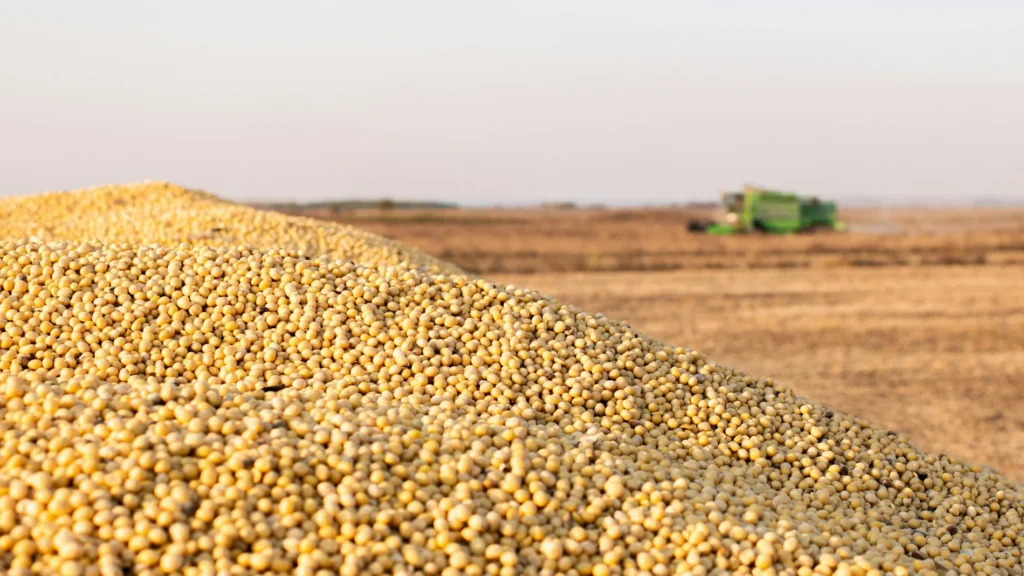
Among all of the EU’s food vulnerabilities, soy is the most extreme case. The report’s figures speak for themselves:
- the EU produces only 9% of the soy protein it consumes: 91% is imported;
- Brazil, the United States and Argentina together supply 86% of all European soy imports;
- around 90% of the soy consumed in the EU goes to animal feed, not food. Soybean meal, the main protein ingredient in animal feed, has a European self-sufficiency rate of just 4%.
Soy, in other words, doesn’t only concern people who eat tofu or drink soy beverages. The average European citizen consumes 60.6 kilograms a year, but 55 of it indirectly: embedded in the meat, milk and eggs that reach their table. It is the feed trough, not the plate, that ties Europe to the ships crossing the Atlantic.
This dependency has heavy consequences. According to the report, «without access to imported protein meal, the EU would lose about 40% of its livestock production capacity»: 15% of beef and milk production, around 40% of pork production, up to 60% of poultry and egg production.
And this is not a hypothetical risk. In 1973 the United States blocked soy exports overnight, causing feed shortages in Europe and Japan. More recently, the war in Ukraine drove up fertilizer costs (and therefore the cost of Brazilian soy), while the 2025 US-China trade dispute reshaped global soy flows within a matter of weeks.
Four strategies, four scenarios
At the heart of the report is a modeling exercise: how can the EU cut soy protein imports by 20% by 2035, equivalent to three million tonnes of protein? Four levers have been identified, spread across the entire supply chain:
- European production of protein crops: growing more legumes and protein crops for human and animal consumption;
- circular use of agri-food side streams: reintroducing safe, protein-rich by-products into the system;
- production of innovative proteins: using biotechnologies such as advanced fermentation to generate new proteins that don’t require soy;
- diversification of consumption: broadening the mix of protein sources in Europeans’ diets.
Three strategies act on supply, one on demand. The report combines them into four scenarios: scenario A is a continuation of current trends, and it misses the target; scenario B concentrates efforts on agriculture and circularity; scenario C on innovation and consumption; scenario D distributes effort in a balanced way across all four strategies.
Balance wins, not the miracle solution
The analysis concludes that only the balanced scenario is truly viable. Every lever has physical and social limits: the land that can be converted to protein crops, the by-products that can be safely recovered, the realistic growth of innovative production capacity, sustainable dietary change over time. The concentrated scenarios reach the target only by pushing one or two levers beyond their limits; the balanced one gets there with every lever comfortably within its own margins.
It’s not just a matter of feasibility. Assessed on social, economic and environmental impacts, the balanced scenario delivers the broadest benefits with the fewest trade-offs, from farm profitability to human health, from emissions to biodiversity. The four strategies also reinforce one another: demand-side measures create the market that justifies investment in protein crops, side streams collected for circular use can feed fermentation, and innovative proteins complement legumes rather than competing with them. A balanced approach also makes the most of regional diversity: every country can build on its own strengths, from areas with a strong legume tradition to the most mature biotech hubs.
For those working on protein diversification the message is clear: more plant proteins on our plates is not an ideological add-on, but one of the four levers without which the numbers simply don’t add up.
A political window not to be missed
The report came out a few days before the European Protein Plan, published by the European Commission on July 7, 2026, and was intended to inform its choices. Its recommendations remain relevant, because they target the dossiers where the plan will need to translate into concrete measures: the post-2027 CAP, the CMO reform, the Biotech Act, public procurement reform, and the EU’s next multiannual budget.
Other powers have already moved: China’s 15th five-year plan explicitly identifies reducing soy imports as a strategic goal. For Europe, the authors write, the window is open now: «For half a century Europe has treated its dependency on imported soy as a fact of modern agriculture. It doesn’t have to be».