The scene is familiar to many parents: a rushed breakfast, a snack in the backpack “because everyone else has one”, the afternoon split between homework and screens. Small everyday gestures that seem harmless, but which over time can contribute to an increasingly widespread problem: excess weight in childhood.
Today more than 2.6 billion people worldwide live with overweight or obesity and, among them, approximately 10% are children and adolescents.
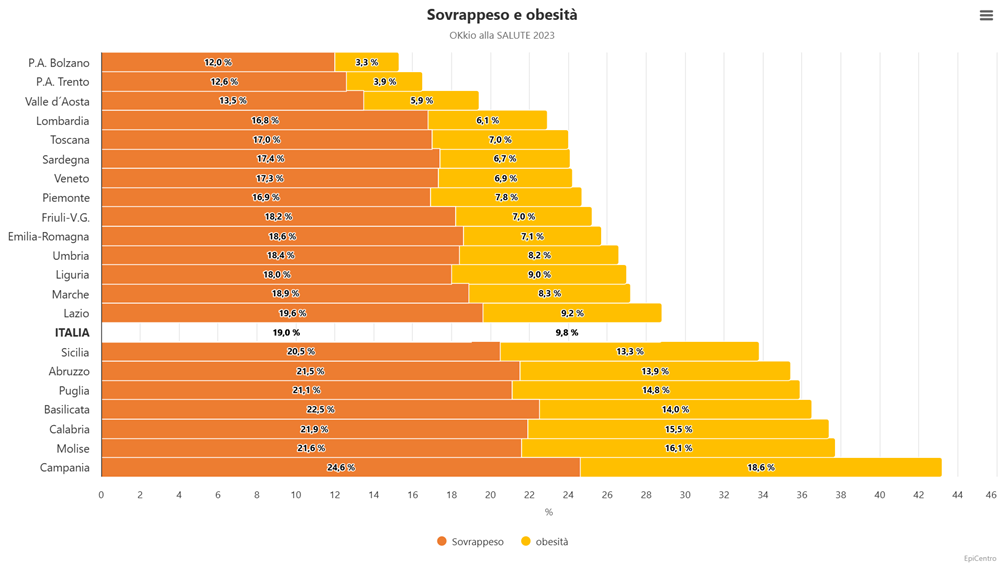
In Italy, surveillance data from the Istituto superiore di Sanità pubblica, Epicentro and in particular OKkio alla SALUTE 2023 (the surveillance system on overweight and obesity and related risk factors in primary school children) confirm the critical situation: almost one third of children are overweight or obese, with higher rates in southern regions and in families with greater socio-economic hardship.
Why the problem is often underestimated
One of the main obstacles is the distorted perception of the problem among families. According to the latest OKkio alla SALUTE report:
- 45% of parents of overweight or obese children perceive them as being a normal weight;
- 73% of parents believe their children do not eat too much.
This is not a matter of superficiality: words like “overweight” and “obesity” are often experienced as stigmatising labels, rather than as clinical indicators useful for preventing future complications. A clearer, more respectful and health-oriented language is therefore needed.
Why excess weight is a health problem (and not an aesthetic one)
Excess weight is not an aesthetic label but a health problem, because it can develop into the so-called metabolic syndrome, a set of conditions affecting various organs and systems of our body that can reduce quality of life and increase mortality in adulthood.
The most frequent complications include:
- type 2 diabetes mellitus,
- arterial hypertension,
- hepatic steatosis,
- orthopaedic disorders,
- psychological and relational difficulties.
As guardians of childhood, we adults must ask ourselves where we are going wrong. Only very rarely does childhood obesity have a secondary origin (genetic alterations or hormonal problems). In the vast majority of cases, it is instead a case of “essential obesity”, linked to poor diet and sedentary behaviour: two drivers that often feed each other in a vicious cycle that is hard to break.
Lifestyles: what is not working today
The OKkio alla SALUTE 2023 data show that, in Italy, there is still a great deal to be done to promote healthy lifestyles.
Physical activity and sedentary behaviour
Almost half of children spend more than 2 hours a day in front of screens (TV, video games, tablets, smartphones)Only one third walk or cycle to schoolLess than half do sport at least twice a week
Often this is not a lack of willpower: safe spaces are lacking, school gyms are inadequate and extracurricular sports activities can be costly.
Unhealthy eating habits
- Around 10% of children skip breakfast
- Nearly 40% have an unbalanced breakfast (too much sugar and fat)
- More than half consume large and unhealthy snacks
- A quarter drink sugary drinks on a daily basis
- Around 40% eat pulses less than once a week
- Around 25% consume fruit and/or vegetables less than once a day
Poor information and ineffective nutritional education have transformed our country, once the cradle of the Mediterranean diet, into one of the European nations with the most critical lifestyle habits and a high incidence of excess weight. At school, the distribution of healthy food is limited and parental involvement in nutritional education initiatives is scarce. At home, difficult socio-economic conditions and the presence of other family members with excess weight make it even more complex to adopt healthy habits.
On top of all this, there is also the weight of cultural habits: in Italy food is tradition, but some customs have changed over time (larger portions, greater use of meats and cheeses, industrial products “inspired” by traditional recipes but with more sugar and fat). These changes have moved us away from the original Mediterranean model, rich in plant-based foods. This is why it is essential that health professionals and teachers provide clear, evidence-based nutritional education, enhancing what is healthiest in tradition.
The importance of plant-based foods and the Mediterranean diet model
In recent years, a great deal of scientific evidence has shown that a diet rich in plant-based foods, as in the Mediterranean diet model, is a valuable ally in preventing excess weight in childhood.
Fruit, vegetables, pulses, wholegrains, nuts and seeds are naturally rich in fibre, vitamins and minerals, and have a lower caloric density compared to many animal-based foods. This promotes satiety without excess calories, contributing to better body weight control.
At the same time, excessive consumption of animal-based foods, especially red and processed meats, cheeses and products rich in saturated fats, is often associated with a greater risk of overweight, obesity and metabolic complications. Reducing their frequency in favour of plant-based protein sources such as pulses, tofu, tempeh and seitan can be a beneficial choice not only for the child’s health, but also for the whole family and for the environment.
Promoting a predominantly plant-based dietary model does not mean imposing restrictions: it means increasing variety, introducing new flavours and new habits that can guide children towards a healthier, more balanced and sustainable lifestyle.
Small changes, great results
Excess weight in childhood is a complex problem, arising from the interplay of family habits, social contexts, dietary choices and opportunities for physical movement. There are no quick solutions, but there are effective pathways: education, awareness and small daily changes that, over time, build the building blocks of health.
Choosing more plant-based foods, reducing animal-based ones, encouraging physical activity and creating a family environment that values wellbeing are concrete steps that every parent can take.
Yet, getting started can seem difficult. It is normal to feel overwhelmed or full of doubts: every family has its own rhythms, its own challenges and its own resources. Let us try, then, to change perspective and tackle the most common doubts together.
I have other children who are not overweight. How do I keep everyone happy?
Excess weight is just one of the possible consequences of an unbalanced diet and a sedentary lifestyle. Improving habits is good for everyone, regardless of weight. Let us think of the change as a collective gift: more energy, more wellbeing, more health for the whole family.
My children don’t eat fruit, vegetables or pulses. I’ve tried, but they refuse everything!
This happens often. The first step is to stop thinking of vegetables and pulses as “side dishes”. If the main courses are too rich in carbohydrates or animal protein, children arrive already full and have no room for anything else.
Some useful strategies:
- Slightly reduce the portions of the main courses, so as to leave room for fruit and vegetables.
- Serve vegetables at the start of the meal, when hunger is greatest.
- Offer pulses as the main course, not as an addition, pairing them with grains and vegetables.
- Simplify preparation: frozen or tinned vegetables and pulses are excellent alternatives and speed up cooking.
- Involve children in choosing and preparing food: touching, smelling, choosing by colour or shape makes everything more fun and less “imposed”. And, above all, let us remember that repeated exposure works: even if they refuse today, tomorrow might be different.
I’d like to get them started in a sport, but it’s complicated: homework, distances, timetables…
This is a very common difficulty. There is no need to aim straight for something demanding: even 40–60 minutes of light aerobic activity a day, such as a brisk walk, helps metabolism and general wellbeing.
Structured sport, however, offers unique benefits: socialisation, discipline, fun, coordination.
We can:
- try a few options to find out what they really enjoy;
- start with light and accessible activities;
- favour team sports, which are often more motivating.
The goal is not performance, but finding a form of movement that makes them feel good.
What about parties? Birthdays? I can’t exactly ban them!
Absolutely not. Food is also about relationships, joy and sharing. Parties must remain a pleasure, not a problem. The important thing is that they are exceptions, not the norm. When eating out, we can still steer choices towards more plant-based and healthier options: today many restaurants and fast food chains offer tasty alternatives that children enjoy too.
At home I can manage their diet better, but what about school, with snacks and the canteen?
For snacks, there are many simple and healthy options:
- fresh fruit that keeps well in a backpack; dried fruit (almonds, walnuts, pistachios, cashews);
- a slice of bread or some plain crackers;
- to drink, always water.
As for the school canteen, active participation can be helpful: joining the canteen committee, suggesting more plant-based dishes, giving constructive feedback. Making your voice heard can truly make a difference.
Conclusions
Investing in children’s health means investing in the future: a future made up of healthier, stronger and more aware adults who are conscious of their choices.
The path to health starts when we’re young, but continues every day in the choices we make at the table and in the lifestyle we decide to embrace.
Every choice, even the smallest one, can make a difference.