
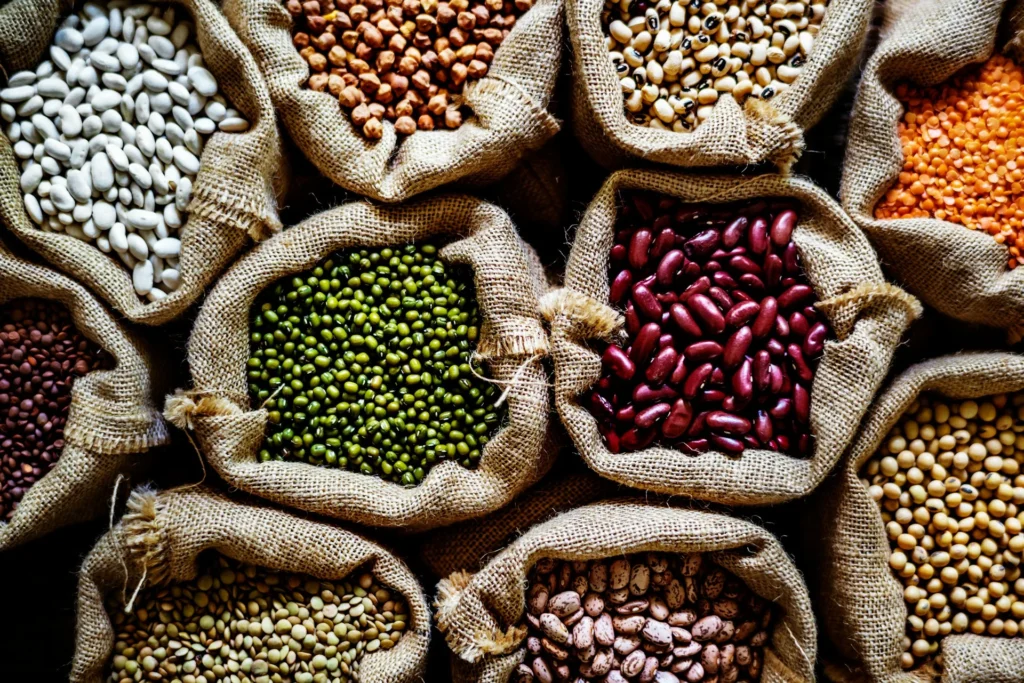
Legumes are the plant foods richest in protein. They include all types of beans (borlotti, kidney, cannellini, butter beans, and other varieties) and lentils (various varieties depending on the region), chickpeas, grass peas, fava beans, lupins, green beans, peas, yellow soybeans, azuki beans (known as “red soy”), and mung beans (known as “green soy”).
Products derived from legumes include flours (commercially available ones include chickpea, pea and soy flour) and soy-based derivatives: milk and yogurt, tofu, tempeh and textured vegetable proteins (these are dehydrated soy: granular, in chunks or in “steaks”).
The plant protein content is similar to that of meat: in legumes, proteins provide on average around 35% of total energy. Even though their content of sulfur amino acids is limited, this is not a problem because these amino acids are largely found in other groups of plant foods, especially grains and nuts, all of which should be consumed regularly as part of a healthy diet. In traditional cuisine, legumes are often eaten together with grains in the same dish, but in reality it is not necessary to consume them in the same meal to achieve adequate protein intake in the diet.
The consumption of plant proteins appears beneficial for gut health, as it promotes the development of a diverse and healthy population of gut bacteria and could reduce the risk of obesity and other chronic diseases including type 2 diabetes, support healthy ageing and a reduction in the risk of frailty in older adults, as well as reducing all-cause mortality and mortality from cardiovascular disease.
The main component of legumes, however, is not protein but complex carbohydrates, which, also thanks to their fibre content, can be slowly absorbed by the intestine without negatively affecting blood sugar levels. Furthermore, legumes contain B-group vitamins (riboflavin, niacin, thiamine, folic acid) and beta-carotene, iron, magnesium, potassium, calcium and zinc. They are also good sources of phytochemical substances, such as phytoestrogens, saponins and tannins. All legumes are low in fat, except soy, which is rich in polyunsaturated fatty acids – including omega-3 fatty acids – and contains no cholesterol.
Legume consumption appears to be protective for health: in various meta-analyses their consumption has been associated with a reduced risk of cardiovascular disease, stroke, all-cause mortality, type 2 diabetes, hypertension and obesity.
It should be emphasised that soy must also be included among legumes; it contains phytoestrogens (the isoflavones genistein and daidzein), important biocompounds with antioxidant properties and a structure similar to the human hormone 17-β estradiol. Among the various myths surrounding plant foods, one very deeply rooted one concerns precisely the isoflavone content of soy, because these compounds have long been considered endocrine disruptors, with negative influences on male fertility and the risk of cancer in women. On the contrary, a meta-analysis of clinical studies has shown that soy proteins and isoflavones are not able to influence testosterone, estradiol, estrone and sex hormone-binding globulin in men, and another recent meta-analysis concluded that the consumption of soy isoflavones may even reduce the risk of breast cancer in pre- and post-menopausal women.
Their beneficial effect has also been reported in other conditions such as endometriosis, menopausal symptoms, skin ageing, osteoporosis, cardiovascular, neurodegenerative, immune and metabolic diseases
In conclusion, legumes are a food whose consumption should be recommended in all types of diets. They can indeed contribute to the nutritional adequacy of a plant-based diet, but above all they can represent a substitute for unhealthy protein sources, such as animal foods, even in diets that are not exclusively plant-based.